Pages

4/26/10

Report to the Grandkids, MMX

Since this is the grandkids farm, it only seems appropriate to give a periodic report on the state of the farm, so here goes part I.

We still own the farm, no liens or encumbrances - Ye Haw!

Soil fertility balance sheet:

  1. (-) We sold a small amount of alfalfa hay last year and about 2 dozen calves
  2. (-) Traded about 25 bales of grass hay for putting up the other 25
  3. (+) We didn't hay all fields - mowed some and let it drop as usual. 
  4. (+) We continue purchasing/bartering for feed concentrate imports
  5. (+) We brought in a good wagon load of straw (with help buckin' from your pregnant Auntie/Mom!). 
  6. (+) Most of our firewood last year was from off farm.
I need to get a couple soil samples to take to the Extension but I'm going to say that we probably are still down some fertility on balance due to putting up hay on shares.

Water
Still my biggest concern long term is water, both quality and availability. We are downhill from two dairies. One uses a lagoon to capture and spread from a freestall barn, the other is more traditional with lots of runoff. I don't mind receiving some of the "tea" that runs off but worry about the groundwater quality as well as level as dairies really use the water.

Good news is there isn't any new (or old) industrial development nearby or uphill, no big CAFO ag barns/lots and no new urban refugee barns either!

Stay tuned for an upcoming post on water.


Improvements:
Capital Improvements [cash costs in brackets]
  1. Greenhouse Project: increased solar gain, new poly roof covering, new (recycled) south glass, hydronic heated benches, propagation cabinet [mostly recycled, $100 plumbing, $75 poly, misc hardware]
  2. New hen house. [a few 2x4s]
  3.  New back steps [recycled lumber, new composition railing]
  4. Still working on Gram's kitchen...
Equipment, facilities:
  1. 9 new calf hutches [2x4s]
  2. New 8x12 calf shed [2x4s]
Cash income/expenses:
Last year was pretty tough cash-wise: Pops got sick, graphics work was virtually non-existent, calf market was in the toilet. But, work has been picking up since the first of the year, calves are bringing better, Uncle Sam is happy for a while, we're working the hospital bill and meds/supplies aren't nearly as bad as we thought.

I was kind of slow this time last year and Gram did lots of the gardening. This year I've been doing more graphics work so she is doing most of the gardening. We had thought this would be the year went much more into market farming as a necessity but we pulled back at the last minute as graphics jobs started coming back. We did wholesale some starts to the feed store, and depending on his success selling them we may put up a small hoophouse this fall.

We ate lots of homemade beef and pork and potatoes and onions and beans last year! We went shopping a couple times at Sam's and used the pantry a lot. We've worked on our few utility bills; the phone is a bare bones plan, the Great Thunder Bottom Internet Antenna is at the lowest level of service available, we have plug strip switches on the Evil Standby Red Eye phantom loads if we can remember to use them and of course we have had curly lamps everywhere since whenever.
We haven't had cable or satellite TV for years but I recently splurged and signed up for Netflix - $8.95/mo - good time are here again! I finally watched Crude Awakening!

All in all, the last couple of years were a good experience. Our income mix is is much improved. Although graphics still comes exclusively from CA, 2 new clients are more diversified than I've had in a long time - health care and small business advertising. We have even more experience with sick calves, one day we hope to be able to keep most alive.

We remembered too that pantries (and Rule #4) are there for a reason.

4/20/10

How Big is Too Big?

The average US home has grown in size from 1,000 square feet in the 1950's to somewhere in the 2,400sf area in the late aughts. At the same time, the number of people per home has dropped from 3.5 or so to 2.5 or about 1000sf per person. 


http://all-classic-ads.com


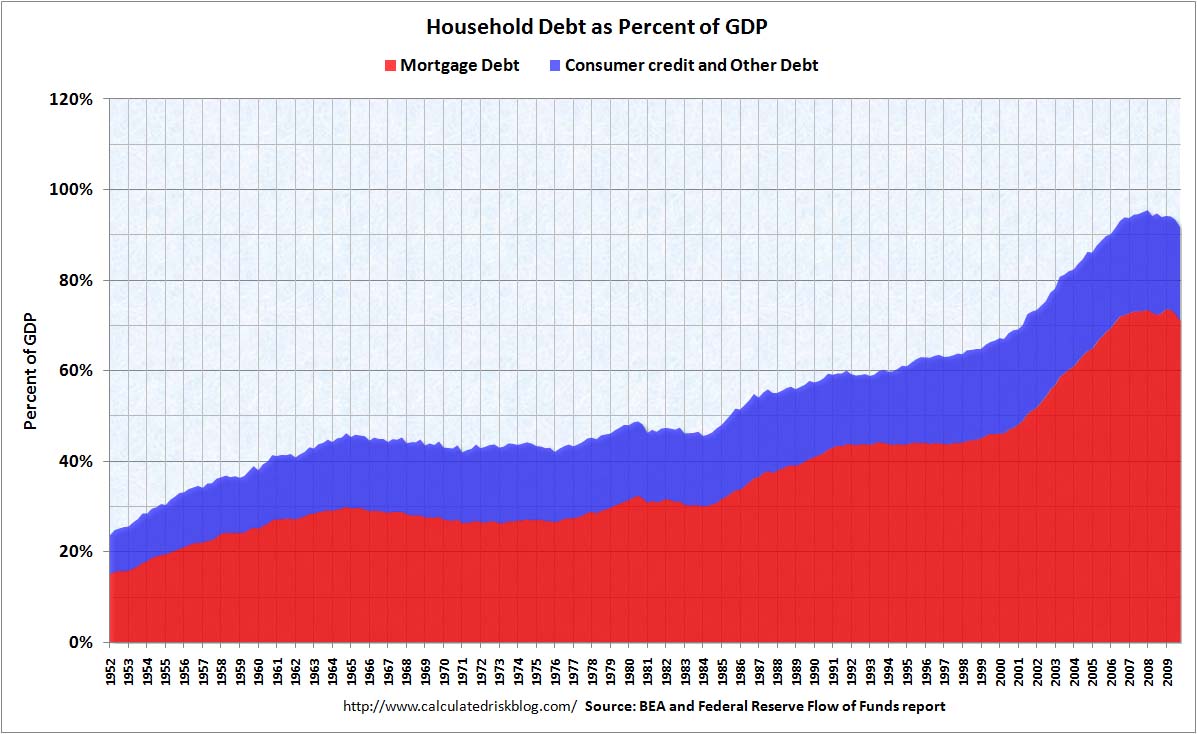
Is it any wonder the amount Americans owe on mortgages has increased from about 20% of the size of GDP to 70% of the size of GDP? Over 2/3 of the value of everything this country makes in a year. That just floors me.


I didn't talk about housing in my 5 Rules mainly because there are so many ways to gain shelter and I obviously have a bias toward small towns and small farms. But if I were to add a sixth rule I think it would be KISS - Keep It Small, Stupid. Granted, we now live in the largest house we've ever owned, but that's the key, we own it.

Several bloggers I read were talking about housing and households this week - Calculated Risk (a great economics site if like me, you understand charts better than equations), John Michael Greer, Sharon Astyk and some others. They talk a lot about declining resources and that dovetails right into the whole idea of a less-is-more lifestyle.

When we decided to abandon CA to the real estate flippers 6 years ago, we had a few criteria; somewhere in the center of the country, east of the treeline and south of the 200-day growing line (think somewhere south and east of central Kansas) - away from cities, 20+ acres of tillable land, 35"+ rain - those we my criteria, plus - - -


 an old 2-story house...


So yea, we have over 1,000sf per person in our house but we don't owe anything to the bank and that makes all the difference. But as far as being the wisest decision, an old house (ours is just under 100 years old) isn't the best. This old place is framed with oak - yep, oak, so it's gonna stand up for a while longer and the foundation and framing are about as straight as they get so I have no qualms about putting in time and money bringing the insulation and mechanicals up to snuff. But it is a long process and if you or yours don't have the experience of living in a work zone for a really long time you need to think long and hard about a fixer.

Much better (if you all the parties can agree) would be building a new, frugal home from scratch. I love this old house and I'm trying to get all the holes plugged and some solar gain but it's tough, starting new with solid plans would get you to frugal fast. I'd build a small, bermed, passive solar house using plastered ICF walls (basically a Styrofoam/concrete sandwich) and galvalume or tile roof. I'd spend all I had on the envelope and finish the interior as I could get the goodies.

There used to be a formula, back in the pre ETF/bundled securities days, it was called a qualifying ratio and when we bought our first house we needed the housing cost to be less than 24% of our gross income and all our loan payments plus mortgage to be less than 28% - oh, and 20% down too.

4/13/10

Dropout Economy


A Time magazine article a few weeks ago really struck a nerve. The premise put forward was kind of a new underground economy populated by dropouts.

As conventional high schools and colleges prepare the next generation for jobs that won't exist, we're on the cusp of a dropout revolution...

As industrial agriculture sputters under the strain of the spiraling costs of water, gasoline and fertilizer, networks of farmers using sophisticated techniques that combine cutting-edge green technologies with ancient Mayan know-how build an alternative food-distribution system. Faced with the burden of financing the decades-long retirement of aging boomers, many of the young embrace a new underground economy, a largely untaxed archipelago of communes, co-ops, and kibbutzim that passively resist the power of the granny state while building their own little utopias.
So I looked up the author - Reihan Salam, like I usually do and was surprised to find he is a conservative. Not that that's a bad thing, just that this little ball-gazing effort was quite liberal - in the strict sense of the adjective:
Not limited to or by established, traditional, orthodox, or authoritarian attitudes, views, or dogmas; 

The dropouts he pointed to were of the young version but the underground economy he imagined could be one I'd fit right into. Today there are a large number of people who've been out of work for a long time, many are indeed blue collar and a large portion are also 50+ undergraduates. Salam thinks unemployment is so cushy and attractive nowadays many freeloaders would rather draw unemployment than find a job. I'd have thought perhaps his vision is more of a conservative's nightmare of the return of long-haired hippy types until this:
The cultural battle lines of our time, with red America pitted against blue, will be scrambled as Buddhist vegan militia members and evangelical anarchist squatters trade tips on how to build self-sufficient vertical farms from scrap-heap materials.
Wow. What a mouthful from anyone even sort-of aligned with any political party.

Anyway, it's a great idea starter for anyone thinking about slipping out of the fast lane...

4/11/10

Rule #5, Don't be Dependent - The Marlboro Man Paradox


Wayne McLaren, the first Marlboro Man, dying of lung cancer at 51


Individualism is participating in society for the sole purpose of furthering one's own interests. The Marlboro Man is the modern icon of individualism. He (at least one of him  anyway) died of lung cancer, I assume because he believed what he was told by those making a profit from his addiction. Philip Morris for it's part was simply furthering it's own interests by lying about the dangers of smoking - that's as individualistic as it gets. It's ironic the icon of individualism died as a result of unfettered individualism.


Americans have this image of themselves as rugged pioneers who sally forth to tame the wilderness - and get rich off it's untapped resources. The Marlboro Man is the perfect icon for this myth, a lone agent rounding up the doggies and trailing them to market. He is Chisholm, Crocker, Comstock and Rockefeller.

Our society is stuck in Manifest Destiny mode but land and natural resources (and wild cattle) free for the taking are quite gone. But like the Marlboro Man with cigarette dangling, we cling to the myth and condemn any suggestion of contributing to a greater good as socialism.

At the same time the nagging feeling that the end of our endless resources is indeed nearing and the theme is often repeated that things may not be better for our kids after all. The result - I guess, is the mass, ugly re-expression of our selfish gene at virtually any political question.


Living at the margin is selfishly individualistic if you are an individual but it could just as easily be a model for collectivists if that's your thing. Taking advantage of society's overflow seems a perfectly normal niche, after all we're omnivores, quite good at invention and utterly adaptable. 

So when I say 'don't be dependent' I'm not talking about trying to be the Marlboro Man, the poster boy of dependence, in fact exactly the opposite. Avoid dependence on the systems we all take for granted, the Just In Time delivery of stuff - food, heat, lights, transportation, entertainment, and perhaps most of all, the 9-5. The added benefit is achieving a measure of resilience in your personal economy that makes you better able to withstand the normal ups and downs of the larger economy and maybe even the turns that aren't so normal.


It's not so difficult to change...

Marlboro had a female target audience till Leo Burnett came up with the Marlboro Man Campaign and changed the brand almost overnight, probably one of the most successful ad campaigns ever...

4/8/10

Rule #4, Don't Get Hungry

"Get Hungry?" I imagine you yelling, "I'm so fat I can't get into my pants! Food is so cheap today how could I ever go hungry?"


Ironically that is exactly the problem. In the rich world today, the cheaper the food, the more likely it's filled with empty calories, made from highly subsidized ingredients like added sugar and Hi Fructose Corn Syrup, over processed grains and added fats. Whole grains, fruits, vegetables fish, etc, are more expensive than a Big Mac menu - and no wonder, the food pyramid and the farm subsidy pyramid are exactly reversed.


In the Rich World, producing the essentials for survival; food, water, shelter, (along with all the diversions in the Bread & Circus isle) are in the SEP Zone (Somebody Else's Problem). The good citizen takes little notice except for paying very close attention to what is the popular, most advertised product of the moment. The citizen's responsibility then is simply to work and consume what's offered in the price category matching their education and income, the lower the income, the emptier the calories, the less you are satisfied, the more you eat, the fatter you get.


Remember Rules 1 & 2 are about getting off the buy-cycle and number 3 is getting rid of your day job, so the wise, edgy person learns to be more ant than grasshopper. Conveniently, since you have less time alloted to "a job", you have more time to devote to your pantry.


Rule 4.(a Stock up.
Fill your pantry with food you buy at the warehouse store and on the sale day and from the local farm and from your own harvest. Once you get it full, just buy, grow enough to replace what you use. Voila! instant Food security.


The pitfall when trying to take advantage of the margins around our current society is mistaking cheap food for good food - exactly the same problem as buying really cheap stuff thinking you are buying stuff really cheap. Low priced, over-processed pre-digested, HFCS/fat/salt laden, individually-wrapped-just-microwave-and-inhale, mystery food is bad for you, just look at the correlation between income and obesity - the less you earn the more you weigh.


Rule 4.2 Grow food.

Wherever you live you can grow some food. Because much of what passes as food at the supermarket is beat into mush - even the good stuff, you need fresh raw fruits and vegies. To be overly simplistic, if you eat some fresh asparagus and leafy greens with your extruded mush and HFCS Whatchmacallit patty, your blood sugar won't spike quite so high or fast so you'll feel satisfied longer. And who knows, you might feed your kids some vitamins and minerals by accident!

On the edge, I 'work' less and make less money so not only do I need to take advantage of the harvests and seasons, it's probably one of the biggest benefits. Our food production system has been ruined just as surely by consumers demanding a product with a quality appearance and a cut rate price as every other product. Foreign manufacturing of some worthless widget sold by a screaming barker on the Bread & Circus channel is silly. But to concentrate food production wherever the overhead is the cheapest is downright dangerous. Today monoculture is the norm, miles and miles of exactly the same crop, every fruit designed to ship. But worse, more and more crops are grown predominately in just one region of the world - then shipped to markets everywhere.

The queue for all the rich world goodies gets chaotic pretty quickly when there is a hiccup. The complicated string of just-in-time deliveries it takes to get those goodies (including your food) to the line is long and always subject to such hiccups. As the system gets more complicated and the string longer I expect it to fail more often.

Do you know where your next meal is right now?

How about the meal you'll eat 7 days from now?

.